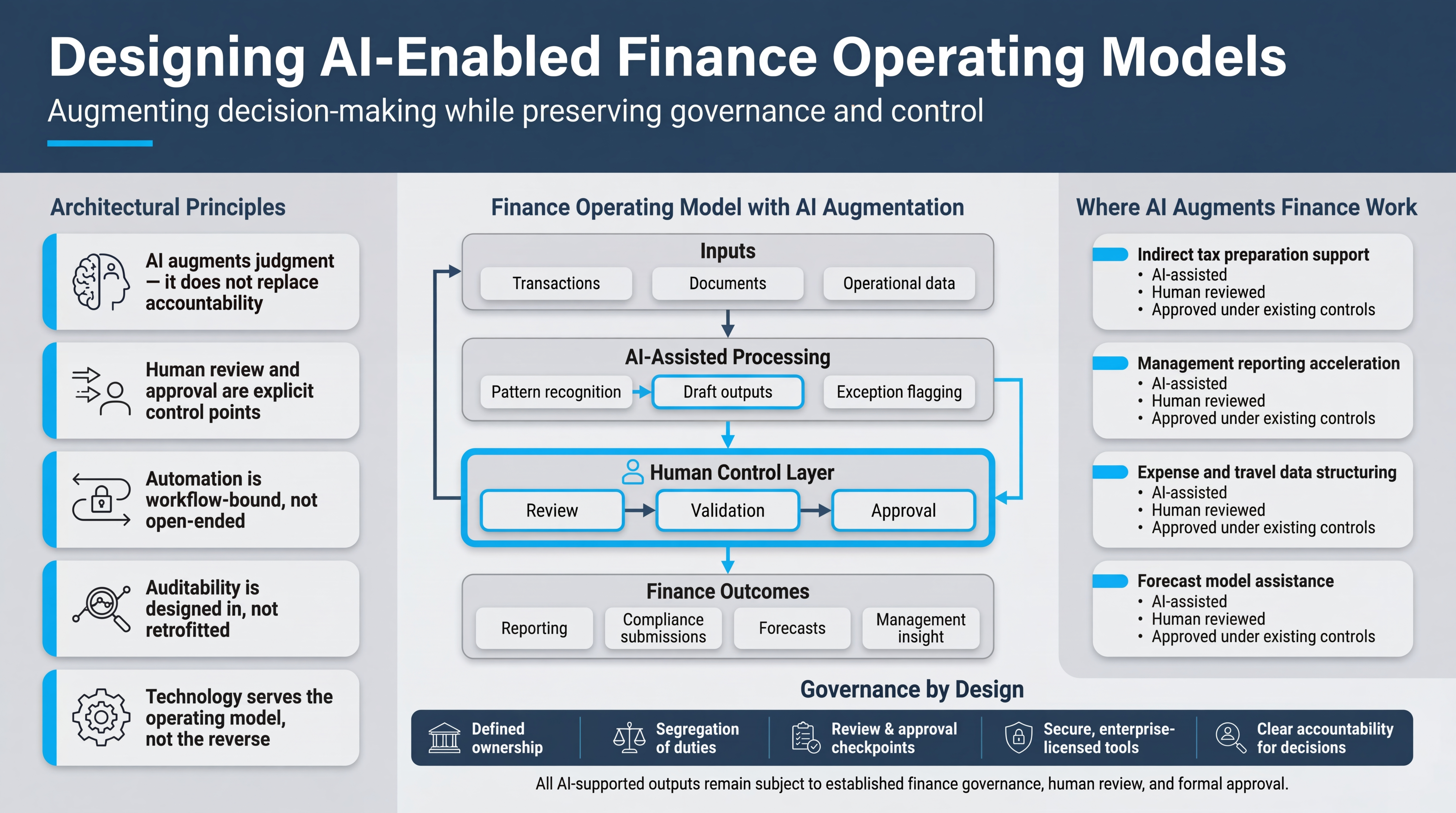
Most AI efforts don't fall short because the technology can't deliver.
They fall short because the business wasn't designed to absorb it.
Reframe
Most AI conversations start in the wrong place.Tools.Pilots.Efficiency claims.All valid.But none of them address the constraint.
Core truth
The limiting factor isn't capability.It's structure.AI only works as well as the system it sits inside.
Shift
And in most businesses, that system hasn't changed.AI is layered on top of workflowsthat were never designed to support it.Which is why it stalls.Or fragments.Or creates more work than it removes.
Principle
AI doesn't create value at the edges.It creates value when it's designed into how the business runs.
Transition
This is what that looks like when it's done properly.
Principles
AI augments preparation and analysis - not decision ownership.Human review and approval are designed in - not added later.Accountability, controls, and auditability remain explicit at every step.
Clarity
This isn't about speed.Or automation for its own sake.It's about defining:Where AI operates.Where judgment sits.And how control is preserved while work still moves faster.
Proof
And when the operating model is designed properly, the results follow.
Broader point
This isn't specific to finance.The same pattern shows up anywhere control, accountability, and auditability matter.HR.IT.Legal.The constraint is the same.
In closing
AI doesn't replace leadership.It raises the bar for what good leadership looks like.
The clearest explanation of how this works in practice is in this conversation with The Handbook: The Operations Podcast, specifically how AI became the reward for building the right foundations, not the starting point.